
From Cadet to Cockpit – A Journey to Becoming a Commercial Pilot
When Jordan Smith talks about flying, there’s an immediate spark in his voice. As a cadet pilot with the Speedbird Pilot Academy, sponsored by British Airways, he’s on the path to joining the flight deck of the Airbus A320 – the aircraft he describes as the ‘baby bus’ of the fleet. He’s just over halfway through his training, having completed his single‑engine commercial phase, and is now preparing for the final multi‑engine stage before moving across to the airline.
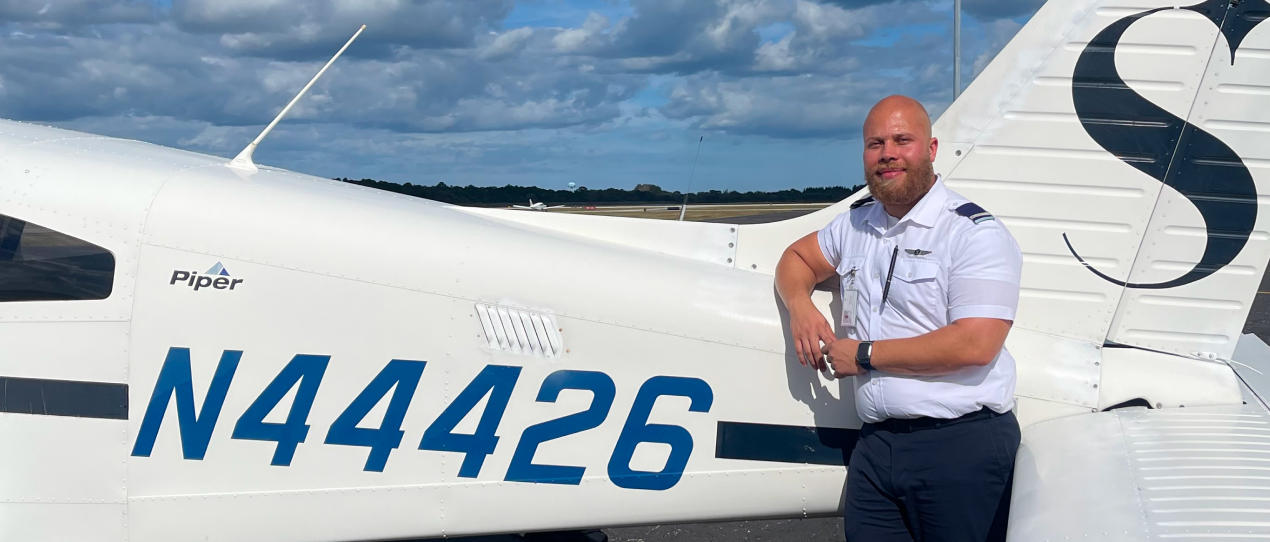
Early inspiration
Jordan’s journey began at 13 with his first flight in a light aircraft through the Honourable Company of Air Pilots. ‘You go one of two ways,’ he says. ‘You either come back and think this is the only thing you ever want to do, or you realise it’s not for you.’ For him, the decision was instant. He continued flying with the Air Cadets, earned a gliding scholarship and completed his private pilot’s licence through a fully funded scholarship.
One striking part of Jordan’s story is that, of the roughly 190 hours he has flown, he has paid for just one – the hour he flew his mum after qualifying for his private pilot’s licence. Everything else came through scholarships, programmes or funded routes. ‘I’m a great example that you don’t have to be rich to become a pilot,’ he says. ‘There are so many opportunities to reduce or even remove the costs.’
Training in Florida
The first major flying phase of his course took place in Vero Beach, Florida. Days began with checking the next morning’s schedule, then preparing for the flight: reviewing the lesson plan, checking weather conditions and looking out for anything unusual at the airfield. After briefing with his instructor and completing all the safety checks, he would take to the air – often with him flying from start to finish.
‘The first time you’re doing everything in the aircraft, it’s exciting,’ he explains. Even for those who hadn’t flown before, the moment they took control was unforgettable. After landing, he would head back for a debrief and then enjoy downtime in the sun – whether that meant the pool, the gym or the beach.
But training has its harder moments. ‘The early mornings are tough,’ Jordan admits. ‘A 6am report means a 4am alarm.’ The industry is also 24‑7, and working across time zones will continue to be part of his life as a commercial pilot.
Why he loves it
Two things keep Jordan motivated. The first is the ‘end goal’. Seeing large jets – including the types he’ll fly – arriving and departing at Vero Beach was a constant reminder of what he was working towards. The second is the view. ‘There are very few jobs where you get views like that,’ he says. On solo flights in particular, he often found himself looking out across Florida’s lakes and open landscape, realising how far he had come.
A career built on determination
Jordan didn’t follow the straightforward route straight from school into flight training. After studying aeronautical engineering at university, he found the aviation industry still recovering from COVID. With few aviation jobs available, he moved into the security sector – eventually becoming a security manager at the FIFA World Cup in Qatar. ‘You develop so many soft skills without realising it,’ he says. Those experiences later helped him at airline interviews, where teamwork and communication are key.
He then worked as cabin crew, deliberately choosing a role that allowed him to learn from pilots every day. When he applied to the Speedbird Pilot Academy the first time, he wasn’t successful. Instead of giving up, he identified what he needed to improve and tried again. He secured a place on the next intake.
Throughout everything, he kept aviation close – even volunteering with organisations like Fantasy Wings and working as their scholarships lead. ‘Even when I wasn’t doing something aviation‑related day to day, I always had something going on in the background to keep me moving forward.’
What it takes to become a pilot
Patience and resilience come up again and again when Jordan talks about the profession. His own journey from 13 to airline training has taken 15 years. ‘It’s not quick,’ he says. ‘You’ll have setbacks and delays, but you need to keep your eye on the end goal.’
Academically, he highlights maths, physics and geography – especially meteorology – but emphasises that students should study what they enjoy. Pilots come from a wide range of backgrounds, and airlines value well‑rounded people with strong communication skills.
Physically, perfect eyesight isn’t required. Many pilots fly with glasses or corrective lenses, as long as their vision meets medical requirements.
Learning to stay calm
While flying is highly technical, Jordan says it’s the teamwork behind the scenes that gives pilots confidence. Before an aircraft even pushes back, engineers, planners, dispatchers and many other specialists have all played their part. ‘Knowing there’s a whole team helping you puts you at ease,’ he explains. Junior pilots also fly alongside experienced captains who have thousands of hours behind them.
Training is designed to prepare pilots for every scenario. ‘Nothing’s left to chance. If something isn’t safe, it won’t happen.’
What’s next
Once Jordan completes his training, he’ll begin his type rating for the Airbus A320. Depending on dates, he could be flying as a second officer by December. For someone who has spent most of his life chasing this dream, the idea of sitting in the right‑hand seat of a British Airways jet still feels surreal. ‘It’s a multi‑million‑pound piece of machinery,’ he says. ‘The responsibility is what makes it rewarding.’
Keep going
Jordan’s advice to young people interested in a career as a pilot is simple – ‘Don’t lose the passion or the drive,’ he says. ‘There’s nothing special about me besides determination and focus. You’ll have moments where you doubt yourself, but don’t lose sight of the end goal.’